June 24, 2026
Most people who want into cybersecurity drown before they start. They open a list of 200 tools, 40 certifications, and a dozen specializations, then freeze. The truth is simpler than the noise. There is a sane order to learn this stuff, and if you follow it, you build real skill instead of collecting random facts. This is that path, start to first job.
No fluff and no gatekeeping. We cover the mindset that keeps you moving, the exact order to stack your skills and certs, the current exam codes for 2026, a few projects that actually prove you can do the work, and a short FAQ. Let us get into it.
The One Rule: Build Before You Specialize
Here is the principle that separates people who land a security job from people who study forever: you cannot secure what you do not understand. Firewalls, SIEMs, and threat hunting all sit on top of networking, operating systems, and how data moves. Skip the foundation and every advanced topic feels like memorizing spells.
So the path below is deliberately boring at the start. Networking and Linux first, security concepts second, specialization last. Resist the urge to jump straight to hacking tutorials. The people who go slow at the bottom move fast at the top.
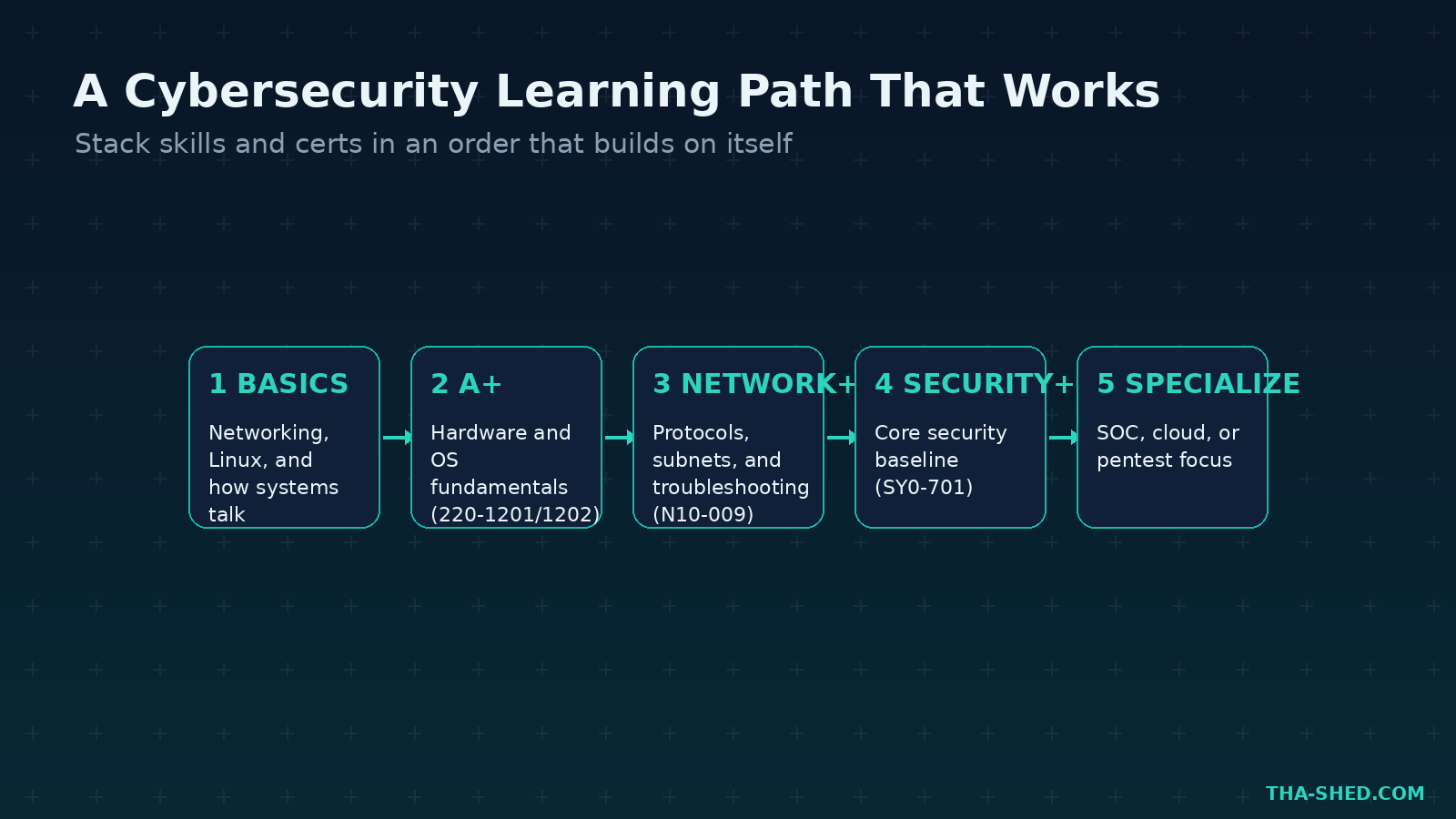
The Learning Path, Step by Step
1. Foundations: networking and Linux
Before any certification, get comfortable with how computers talk and how a server actually works. Learn the OSI model, TCP/IP, DNS, DHCP, subnetting, and ports. Then live in a terminal. Spin up a Linux virtual machine and use it daily. Our Linux CLI Coach is built exactly for this stage, so you practice commands instead of just reading about them.
2. CompTIA A+ for the hardware and OS base
A+ is optional if you already work in IT, but for true beginners it cements hardware, operating systems, and troubleshooting habits. The current version is Core 1 and Core 2, exam codes 220-1201 and 220-1202, which released in March 2025. If you want a structured run at it, the CompTIA A+ Cert Coach walks you through both cores.
3. CompTIA Network+ for the plumbing
Security is mostly applied networking. Network+ (current code N10-009) drills protocols, subnets, network design, and troubleshooting until they are second nature. Skipping this is the most common mistake beginners make, and it shows the moment someone asks them to read a packet capture.
4. CompTIA Security+ for the baseline
This is the credential most entry-level security jobs ask for by name. Security+ (current code SY0-701) covers threats, cryptography, identity, risk, and incident response. It is the single highest-leverage cert for getting your foot in the door. Use our CompTIA Security+ Cert Coach to drill the objectives and practice questions until the exam feels routine.
5. Pick a specialization and go deep
Now you choose. The common on-ramps are the Security Operations Center analyst role, cloud security, and penetration testing. SOC is the most accessible first job: you learn a SIEM, triage alerts, and build muscle memory for real incidents. Cloud security pairs well with an AWS or Azure path, and pentesting rewards people who love breaking things on purpose. Whatever you pick, build depth in one lane before you spread out.
Prove It With Projects
Certs open the door. Projects get you hired. Hiring managers want evidence you can actually do the work, so build a small portfolio as you study.
- Home lab. Run a few virtual machines, one attacker and one target, on an isolated network. Break into your own boxes and document what you did.
- Build a tiny SIEM. Ship logs from your lab into an open-source stack, then write detection rules and screenshot the alerts firing.
- Capture the Flag. Work through beginner CTF challenges and write up your solutions. The write-ups matter as much as the solves.
- Automate something. Script a log parser or a small scanner. Pairing security with a little coding makes you far more valuable, and it overlaps neatly with a DevOps skill set.
Gotchas to Avoid
A few traps swallow beginners whole. Dodge them and you save months.
- Cert collecting. Three certs and zero projects is a weaker resume than one cert and a real home lab. Balance both.
- Tutorial loops. Watching videos feels like progress. It is not. Build something the moment you learn a concept.
- Skipping the boring base. If networking and Linux feel shaky, every advanced topic will too. Go back and shore it up.
- Tool obsession. Employers hire for fundamentals and judgment, not for memorizing one vendor’s dashboard. Tools change, concepts do not.
Skills That Matter More Than Any Cert
Certifications get you past the resume screen, but a handful of durable skills decide whether you keep the job and get promoted. Build these in parallel with everything above.
Learn to read logs without panicking, because most security work is pattern recognition across noisy data. Get comfortable with a scripting language, ideally Python, so you can automate the repetitive parts and parse data fast. Practice writing clearly, since a finding nobody understands is a finding nobody fixes, and a crisp incident summary is worth more than a clever exploit. Finally, build the habit of curiosity. The defenders who last are the ones who ask “why did that happen” and keep pulling the thread until they know.
None of these show up on an exam objective, yet they are exactly what separates a junior who plateaus from one who grows into a senior role. Treat them as part of the path, not as extras.
How Long Does This Take?
Studying part time, a motivated beginner can reach Security+ in roughly six to nine months, and a first SOC role often follows within a year if the projects are there. Move faster if you already work in IT. The timeline matters less than consistency. An hour a day beats a frantic weekend every single time.
FAQ
Do I need a degree to work in cybersecurity?
No. Plenty of analysts break in with certifications, a home lab, and demonstrable skill. A degree can help with some employers and with later management roles, but it is not a hard requirement for an entry-level security job in 2026.
Which certification should I get first?
If you are brand new to IT, start with A+ then Network+. If you already have IT experience, go straight for Security+, since it is the credential most entry-level security postings list by name.
Is cybersecurity still a good career in 2026?
Yes. Demand for defenders keeps outpacing supply, and the rise of AI has added new attack surfaces rather than removing the need for skilled humans. The field rewards people who keep learning, which is the whole point of a path like this.
Start Today
Pick step one and start this week. Spin up a Linux virtual machine tonight, learn the OSI model tomorrow, and keep stacking. The path is long, but it is well worn, and every step builds on the last.
Want guided, hands-on coaching through each cert instead of going it alone? Explore the programs on Our Courses and turn this roadmap into a real career.