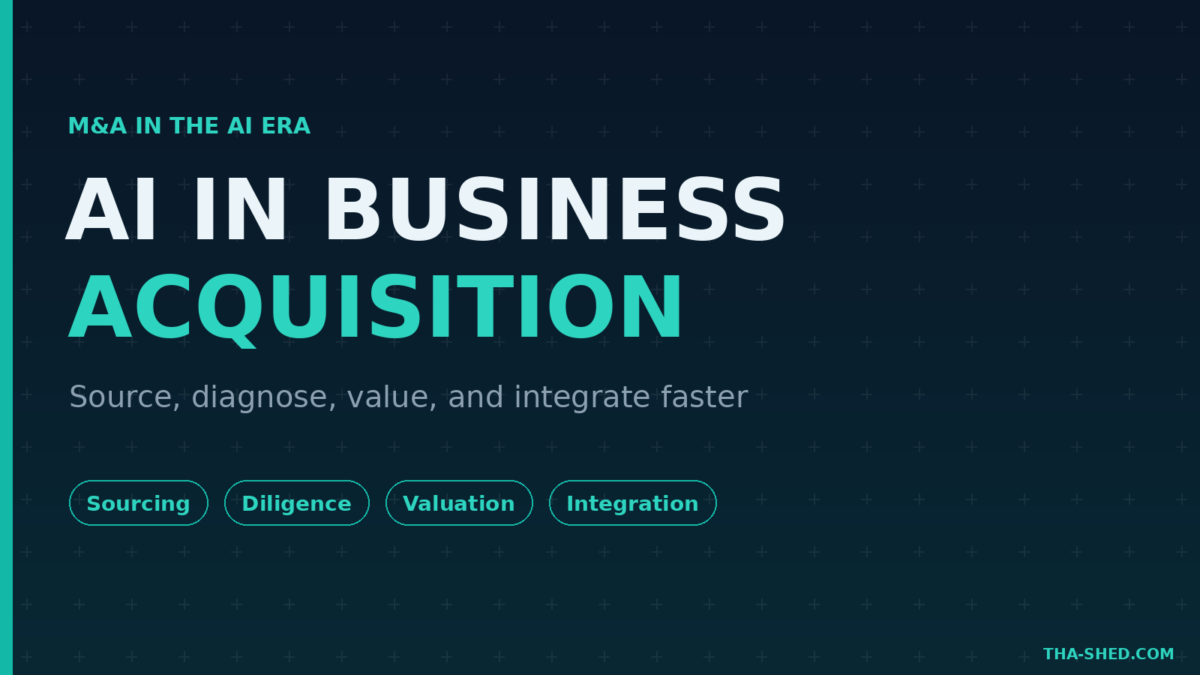
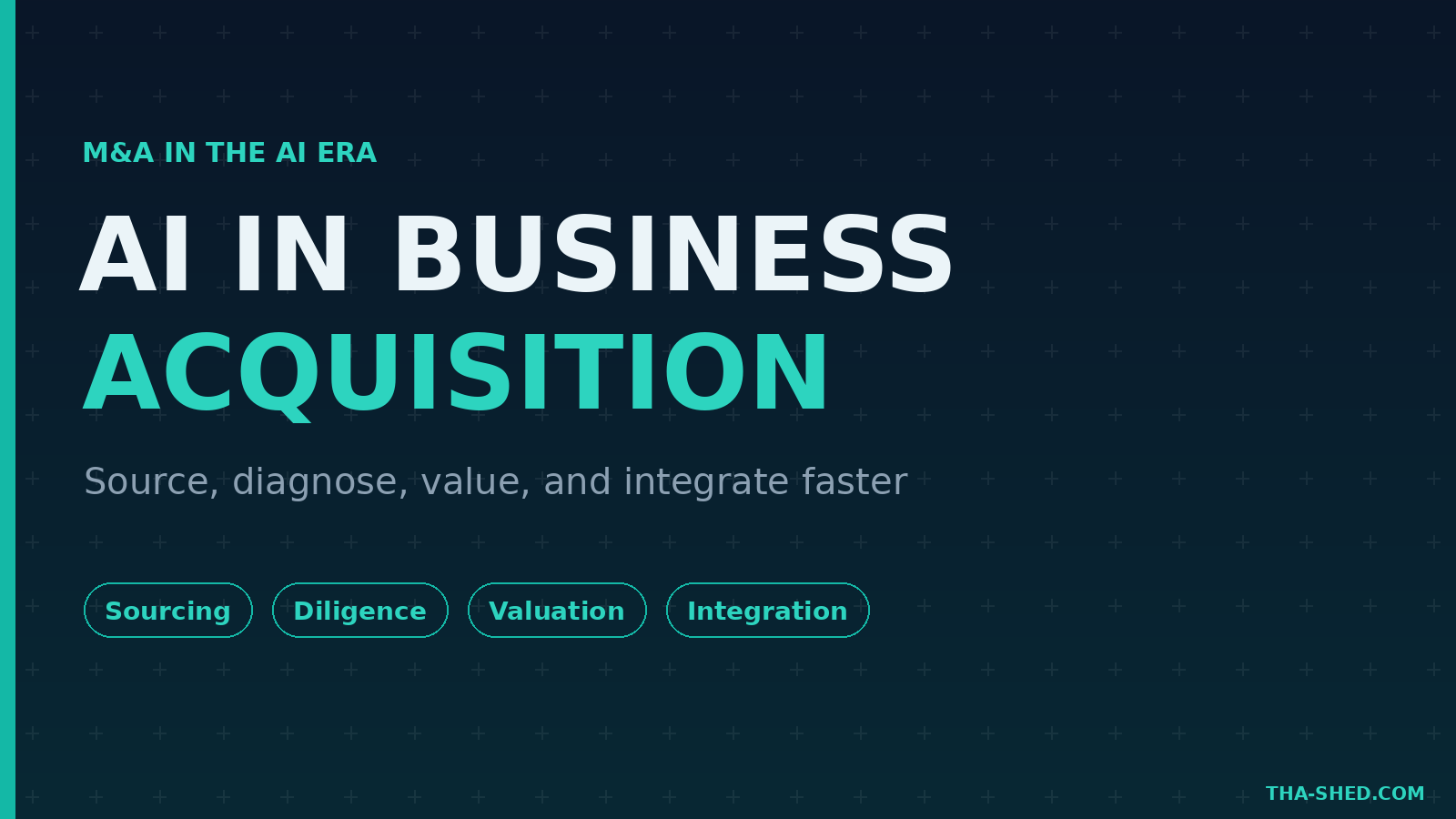
Buying a company used to mean armies of analysts reading contracts until 2am. In 2026 that work looks very different. AI now scans thousands of targets, reads entire data rooms, benchmarks valuations, and maps integration plans, and it does it in a fraction of the time. The dealmakers winning right now are not the ones with the most analysts. They are the ones who point AI at the right problems and keep humans on the decisions that matter.
This is a practical look at where AI actually plugs into a business acquisition, what to automate, what to never hand off, and how to think about the tooling. Whether you are buying your first small business or running corporate development, the shape of the work is the same.
Why This Matters Now
Adoption stopped being a question. Roughly 86 percent of organizations have already folded generative AI into their M&A workflows, and most of them did it in the last year. Nearly 80 percent of teams using AI in deals report a significant drop in manual work. When that much of the market moves at once, doing diligence the slow way is no longer just expensive. It is a competitive disadvantage.
The reason is simple. Acquisitions are drowning in documents and starved for time. AI is very good at reading mountains of text fast and surfacing the few things a human needs to look at. That is the whole game.
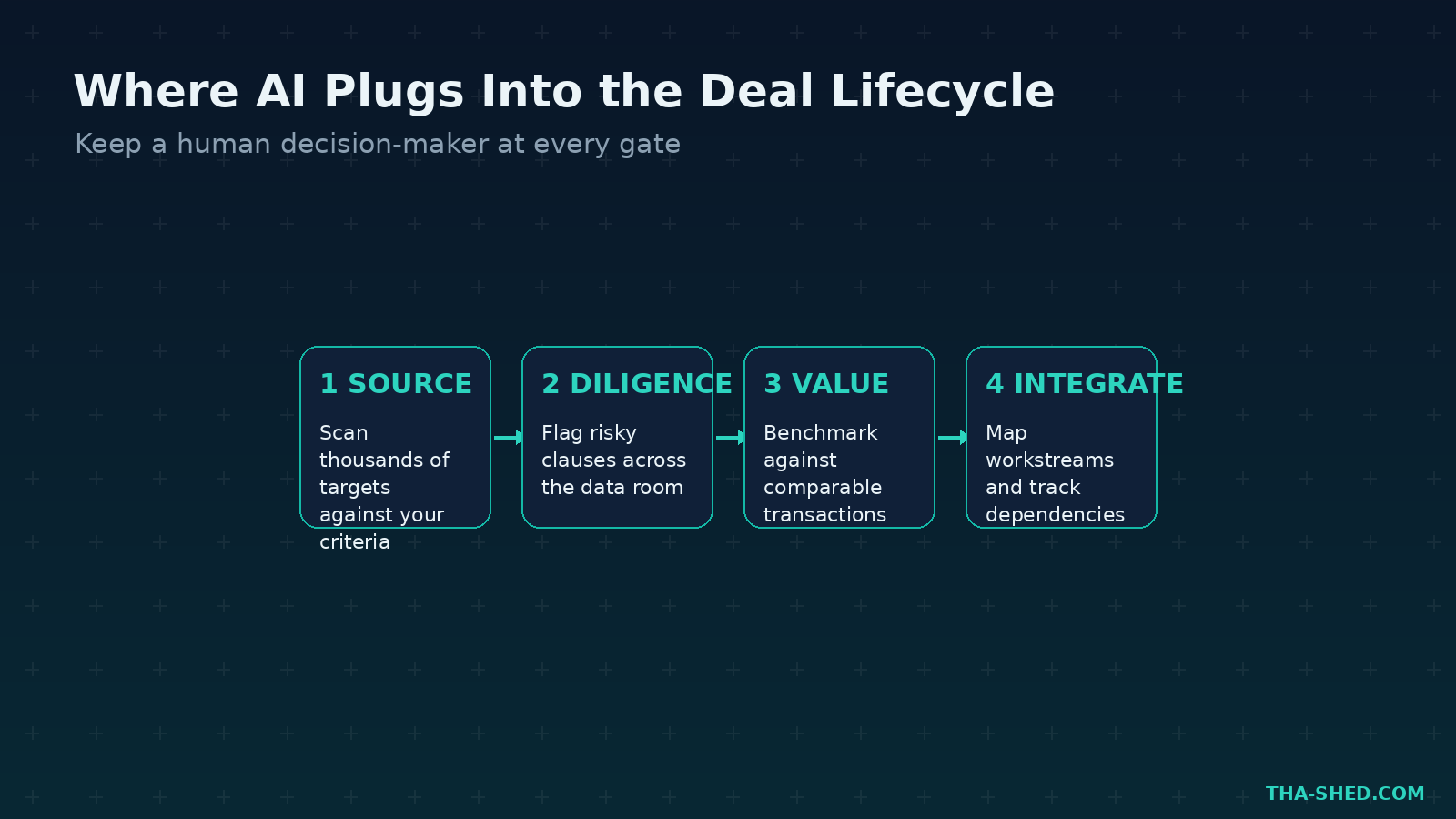
Where AI Plugs Into the Deal
1. Deal sourcing
Finding the right target is a search problem, and search is where AI shines. Modern platforms scan thousands of companies across many data sources at once, filtering for your strategic, financial, and regulatory criteria. They also watch for signals that an owner might be ready to sell, like leadership changes or shifts in performance. Instead of a junior building lists by hand, you get a ranked shortlist and spend your time on judgment.
2. Due diligence
This is the biggest win. AI reads the entire data room and flags material contingencies, non-standard provisions, deviations from market norms, and internal contradictions. It can cross-reference clauses across hundreds of contracts to catch conflicts a tired human would miss. Purpose-built tools trained on millions of legal documents hit better than 90 percent accuracy on standard contract clauses. The point is not to replace your lawyers. It is to send them straight to the 5 percent of pages that actually carry risk.
3. Valuation
AI models weigh many variables at once to produce a more nuanced valuation, then benchmark it against comparable transactions and model different deal structures. This is decision support, not a verdict. The output gives you a defensible starting range and a list of assumptions to challenge, which is exactly what you want before you negotiate price.
4. Integration
The deal is not done at signing. Post-merger integration is where value is won or lost, and AI helps by mapping workstreams, sequencing closing conditions, and flagging dependencies across HR, IT, finance, and procurement. One consolidator used AI to map more than 40 integration workstreams and finished its transition about 20 percent faster than comparable deals. Checklists and timelines that used to take weeks now take days.
The Mindset: AI Drafts, Humans Decide
Here is the principle that keeps AI-assisted deals out of trouble: let AI do the reading and the first draft, but never let it make the call. AI accelerates analysis. It does not own the decision. Final judgments on what to pay, what to walk away from, and how to structure terms stay with people who carry the accountability.
Treat every AI output as a smart intern’s first pass. Fast, broad, and usually right, but in need of a senior review before anything is signed. That framing gets you the speed without the blind spots.
Risks and Gotchas
The upside is real, and so are the failure modes. Manage them deliberately.
- Confidentiality. Deal data is among the most sensitive material a company handles. Use tools with clear data handling terms, and never paste a target’s documents into a consumer chatbot.
- Hallucinated certainty. AI can state a wrong reading of a clause with total confidence. Verify anything that drives a number or a go or no-go decision.
- Garbage in, garbage out. A messy or incomplete data room produces a confident but misleading analysis. Validate the inputs first.
- Regulatory exposure. Antitrust and disclosure rules still apply, and an AI shortcut is not a defense. Keep counsel in the loop on anything material.
- Over-automation. The relationships and human read of a management team cannot be outsourced to a model. Some of the most important diligence happens across a table, not in a data room.
For a deeper look at the diligence side specifically, see our companion piece on AI agents for M&A due diligence.
How to Start Small
You do not need a six-figure platform to benefit. Start with one workflow on one deal. Use a document-aware AI assistant to summarize a single contract and list the clauses that deviate from standard. Compare its output to your own read. Once you trust it on small pieces, expand to a full data room, then to sourcing and integration. The market is moving toward unified platforms that link all four stages, but you can capture most of the value today by being disciplined about where you point the tool.
What to Automate and What to Keep Human
A simple rule of thumb keeps you on the right side of the line. Automate the work that is high volume and pattern-based, and keep the work that is high stakes and relationship-based.
Hand to AI the first read of every contract, the extraction of key terms and dates, the building of comparable-company lists, the cross-checking of clauses across a data room, and the drafting of integration checklists. These are exactly the tasks where speed and consistency beat human stamina, and where a missed line in document 300 of 400 can cost real money.
Keep with humans the read of a management team, the negotiation of price and terms, the call on cultural fit, the final risk assessment, and the decision to proceed or walk. These depend on context, judgment, and accountability that no model carries. The teams that get the mix right move fast on the busywork and stay slow and careful on the decisions that define the deal.
FAQ
Can AI value a business on its own?
No. AI produces a benchmarked range and surfaces the assumptions behind it, which is genuinely useful. But valuation involves strategy, negotiation, and risk appetite that belong to humans. Use the model to inform the number, not to set it.
Is it safe to put deal documents into an AI tool?
Only with the right tool and terms. Choose enterprise platforms with clear confidentiality and data handling commitments, ideally ones that do not train on your data. Keep highly sensitive material in a secured deal environment rather than a general-purpose chatbot.
What is the single best place to start with AI in acquisitions?
Due diligence. It is the most document-heavy, time-pressured stage, so it offers the fastest and clearest payback. Master it there, then extend AI into sourcing, valuation, and integration.
The Takeaway
AI has changed the economics of buying a company. The reading, sorting, and first-draft analysis that once consumed teams now happens in hours, which frees skilled people for the judgment that actually closes good deals. Use it to go faster, keep a human at every gate, and you get the best of both.
Want to build the AI and automation skills behind workflows like these? Check out the hands-on programs at Our Courses.