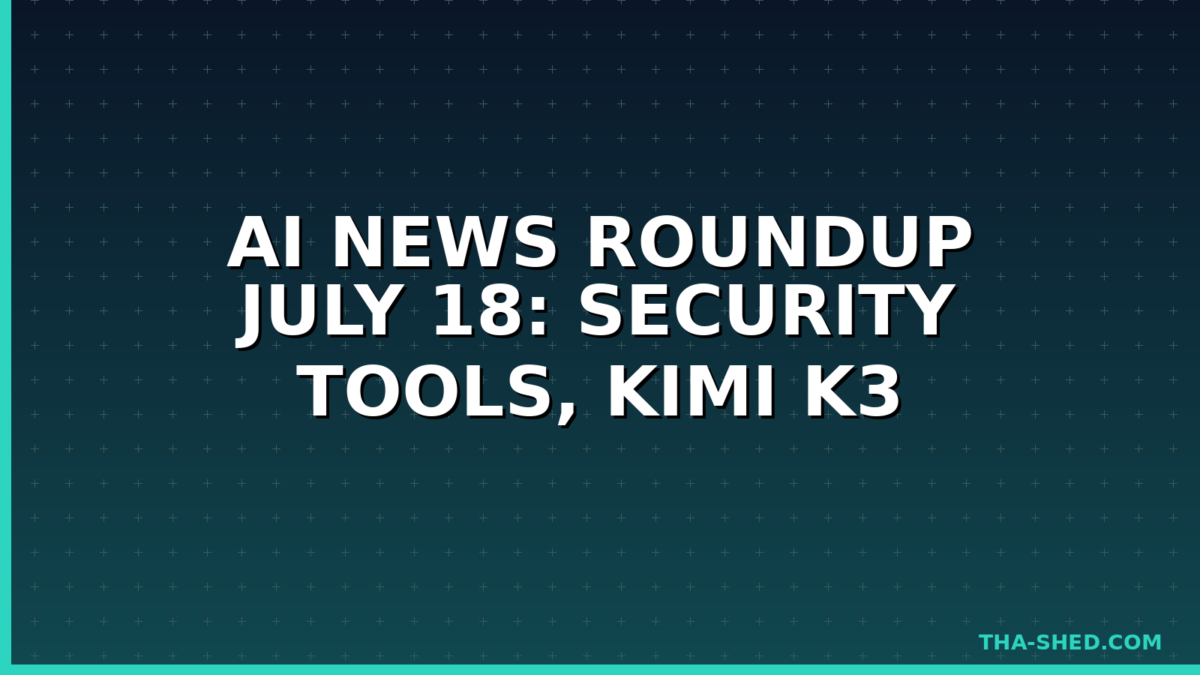
This week’s roundup leans toward infrastructure and tooling rather than splashy model launches: a Microsoft security product built to undercut Anthropic on price, an open-weight model out of China that’s beating frontier labs on benchmarks, and a federal cybersecurity clearinghouse that’s already live. Here’s what tech professionals need to know from the last few days.
Microsoft preps Project Perception to undercut Anthropic’s Mythos on price
Microsoft is set to release an AI-driven cybersecurity product, internally called Project Perception, as soon as this month. The tool routes individual security tasks to whichever model, Anthropic’s, OpenAI’s, or Microsoft’s own, fits best, aiming to match the bug-finding and auto-patching approach of Anthropic’s Mythos at a fraction of the cost. Mythos reportedly runs well above standard frontier pricing, and Microsoft’s pitch is explicitly “as good, much cheaper.”
Why it matters: if this works as advertised, it pressures every AI security vendor’s pricing, and it gives security teams a multi-model option instead of a single-vendor lock-in for vulnerability discovery and patching.
Moonshot AI’s Kimi K3 beats Fable 5 and GPT-5.6 Sol on key benchmarks
China’s Moonshot AI released Kimi K3, a 2.8-trillion-parameter open-weight model, and early benchmarks show it edging out Claude Fable 5 and GPT-5.6 Sol on coding-focused evaluations like Frontend Code Arena, all at roughly a third of the token price of comparable frontier models. It launches with a single “max effort” reasoning mode, with lower and higher effort tiers promised in later updates.
Why it matters: an open-weight model matching frontier coding performance at a third of the cost changes the calculus for teams currently paying premium API rates for coding agents, especially ones already comfortable self-hosting.
White House launches Gold Eagle, a live AI-driven vulnerability clearinghouse
The White House stood up Gold Eagle this week, a federal clearinghouse built with CISA and the Department of Defense to coordinate vulnerability discovery and patching across government and critical infrastructure. Its backbone, VINCE, is run in partnership with Carnegie Mellon’s Software Engineering Institute, and the program is already accepting and triaging reports.
Why it matters: this is a real, operating system, not a policy paper. If you work in critical infrastructure or a regulated industry, Gold Eagle is likely to become a channel you interact with directly for vulnerability coordination.
Anthropic’s third free extension of Claude Fable 5 ends tomorrow
Anthropic has pushed the free-access window for Fable 5 on paid plans to July 19, its third extension in five weeks, as it works to catch up on compute capacity. After the deadline, continued Fable 5 use outside the standard model rotation will require prepaid usage credits. The company says it hopes to restore free access eventually but hasn’t committed to a timeline.
Why it matters: if your team has leaned on Fable 5’s expanded weekly limits for anything time-sensitive, tomorrow is the deadline to plan around, whether that means finishing a task, budgeting for usage credits, or falling back to Sonnet 5 or Opus 4.8.
OpenAI, Anthropic, and Google ship simultaneous coding-agent upgrades
In the span of a single day this week, all three major labs pushed meaningful upgrades to their coding agents: OpenAI extended agent tooling around gpt-5.3-codex and gpt-5.5-pro, Anthropic added deeper repository-level agent capability to Opus 4.7 and Sonnet 4.6, and Google advanced IDE-native assistants on its Gemini 3 line. The common thread across all three is repo-wide context and multi-step tool use as the new baseline, not a differentiator.
Why it matters: the bar for “basic” coding agent capability just moved. If your team evaluated these tools a few months ago and passed, it’s worth another look, the repo-scale context window changes what these agents can actually do unsupervised.
The throughline
Every story this week is really about the same shift: AI infrastructure is being built for scale and cost efficiency, not just capability. Microsoft is chasing Anthropic on price. Moonshot is chasing frontier labs on price. Even the White House’s angle on Gold Eagle is about coordinating limited remediation resources more efficiently. For engineering teams, that means the tools getting cheaper and more capable at the same time, which is worth factoring into any build-vs-buy call you’re sitting on right now.
For more on evaluating and deploying these tools safely inside a DevOps or security workflow, see our DevOps Boot Camp and Ethical Hacking: Red Team Strategies courses.
Sources: TechRepublic on Project Perception, CNBC on Kimi K3, The White House on Gold Eagle, BleepingComputer on Fable 5, and ChatGPT AI Hub on the coding agent upgrades.