Buying a business used to be a game of who had the biggest Rolodex and the most analysts. In 2026 a solo operator with the right AI stack can source, screen, and diligence deals at a pace that used to take a small team. The tooling caught up fast. Nearly half of dealmakers now use AI almost every day, and the vast majority of organizations have already folded generative AI into their deal workflows.
This is a practical playbook for using AI and agentic AI to acquire a business, whether you are a searcher buying your first company, an operator bolting on a competitor, or a corp dev team running deals at scale. No hype. Just the stack, the workflows, and the traps.
What “Agentic AI for Acquisition” Actually Means
A regular chatbot answers a question. An agentic system takes a goal, breaks it into steps, calls tools, and works through the whole task while you watch. For acquisition, that means an agent that can search company databases, pull filings, read a data room, summarize contracts, and draft outreach, all chained together instead of you copying and pasting between ten tabs.
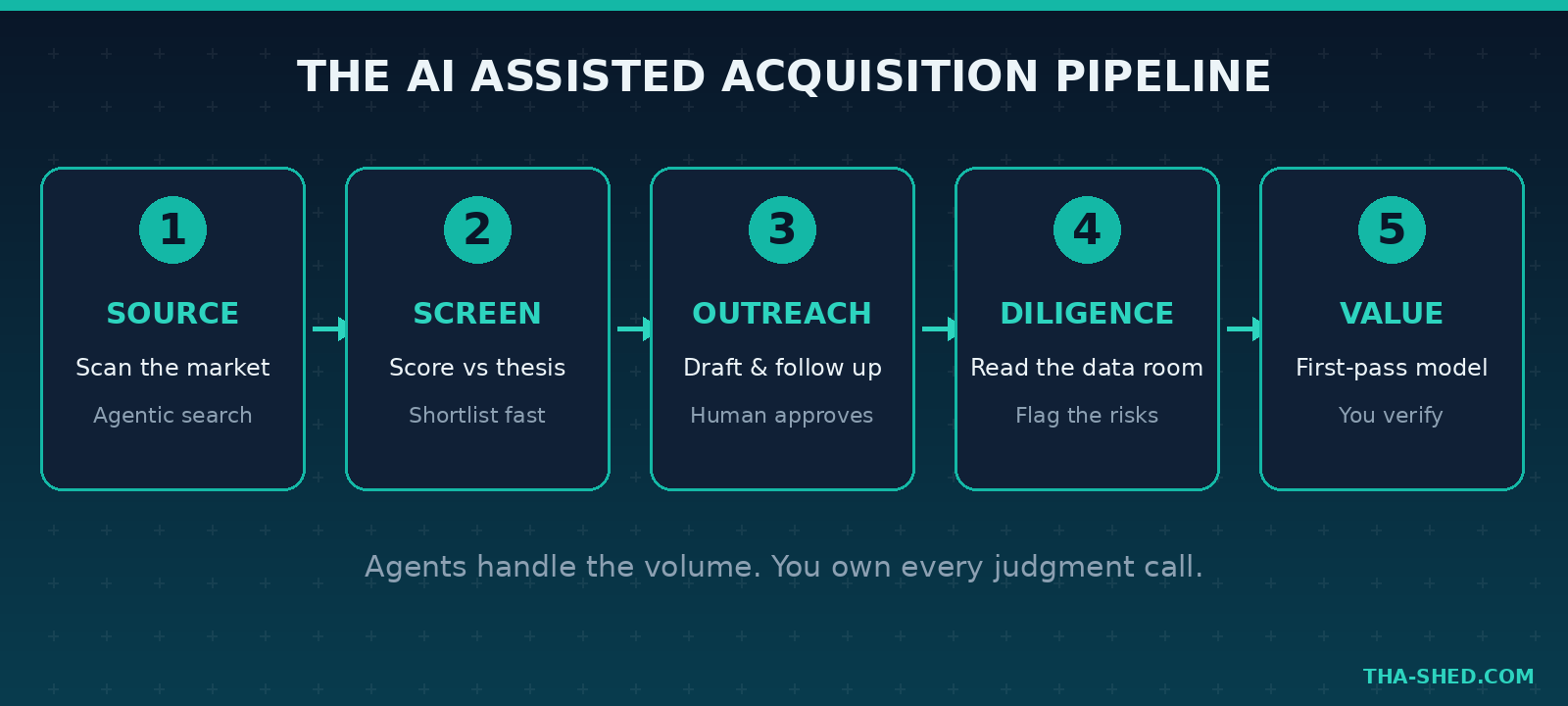
The acquisition process has five stages where AI earns its keep: sourcing targets, screening them against your thesis, outreach, due diligence, and a first-pass valuation. Agentic tools are moving from experiment to production across all five. Specialist platforms like Grata, PitchBook, and Datasite handle sourcing and the data room, while contract-review engines like Kira Systems speed up diligence. General agents built on Claude, ChatGPT, or frameworks like CrewAI and n8n glue the workflow together and automate the repetitive parts.
Quick Setup: Your Acquisition Stack
You do not need an enterprise budget to start. A workable stack has three layers:
- A reasoning model. Claude or ChatGPT for analysis, summarizing, and drafting. This is your analyst.
- A sourcing source. A deal database such as Grata or PitchBook if you can afford it, or public filings, broker listings, and LinkedIn if you are bootstrapping.
- An automation layer. A no-code agent builder like n8n or a multi-agent framework like CrewAI to run repeatable jobs, such as nightly target scans and outreach follow-ups.
Start with just the reasoning model and a spreadsheet. Add the database and automation once you have proven your thesis and your deal volume justifies the cost.
The Principle: AI Builds the List, You Make the Call
Here is the rule that keeps you out of trouble. AI is brilliant at breadth and terrible at judgment. It can scan ten thousand companies overnight and rank them. It cannot tell you whether the owner is actually ready to sell, whether the numbers smell wrong, or whether the culture will survive the deal. Those are your calls.
So you let the agents do the volume work, the searching, summarizing, and first drafts, and you reserve your attention for judgment and relationships. The buyers who lose money are the ones who trust a model output as fact. The buyers who win treat every AI claim as a lead to verify, not a conclusion to act on.
6 Workflows That Move Deals Forward
1. Build a target list from a thesis
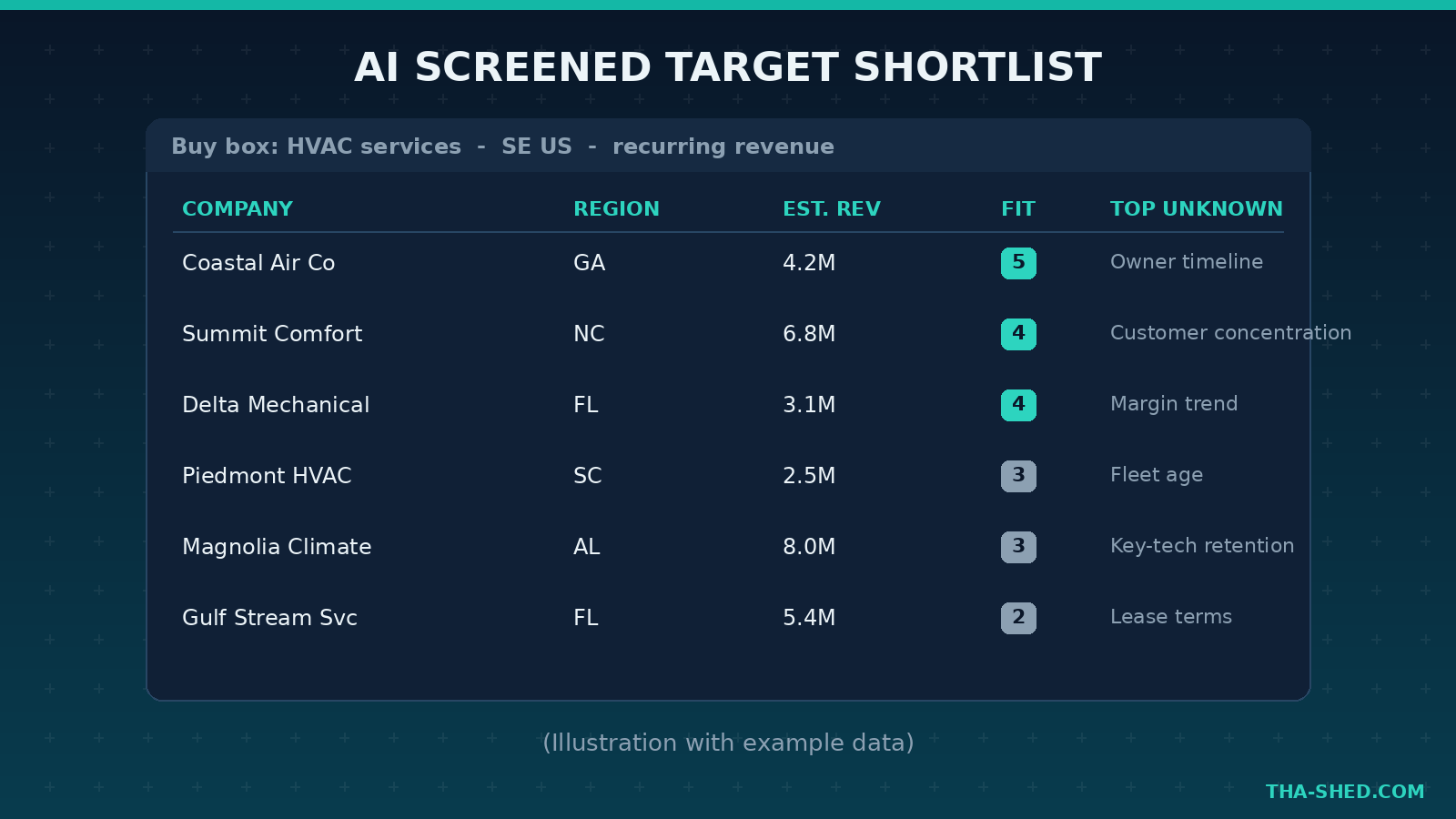
Write your buy box in plain English and hand it to an agent: “Find HVAC service companies in the US Southeast with an estimated 2 to 10 million in revenue, owner likely near retirement, and a recurring maintenance contract base.” A sourcing tool with agentic search returns ranked matches. A general model can then enrich each one with a short summary.
2. Screen targets against your criteria
Paste a list of candidates and ask: “Score each company 1 to 5 on fit with my thesis, flag the three biggest unknowns for each, and tell me what single data point would most change the score.” You go from a hundred names to a shortlist of ten in an afternoon.
3. Read filings and financials fast
Drop a profit and loss statement or a teaser into the model and ask: “Summarize the revenue trend, margin structure, and customer concentration. List the five questions I should ask the seller before signing an LOI.” It will not replace your accountant, but it gets you to the right questions in minutes.
4. Automate seller outreach and follow-up
Use n8n or CrewAI to run a polite, personalized outreach sequence: draft an intro referencing something specific about the business, wait, send a follow-up, log replies. The agent drafts, but you approve every message before it sends. This is where automation shines and also where it gets you in trouble if you let it run unsupervised.
5. Accelerate due diligence in the data room
Once you are under LOI, contract-review tools and a reasoning model can triage the data room. Ask: “Review these supplier contracts and flag any change of control clauses, auto-renewals, and unusual termination terms.” Agentic diligence cuts the grind of reading every document, so your advisors spend their hours on the genuinely tricky issues.
6. Build a first-pass valuation
Hand the model the financials and your assumptions: “Build a simple valuation range using an EBITDA multiple of 3 to 5, show the math, and list every assumption you made.” Treat the output as a sketch you pressure-test, never as the number you put in the offer.
Safety and Gotchas
This is where money and deals get lost, so read carefully.
Confidentiality is everything. Do not paste a seller’s confidential financials or anything under NDA into a consumer AI tool that may train on your inputs. Use an enterprise tier with data controls, or keep sensitive documents in a purpose-built secure data room.
Verify every number. Models hallucinate figures with total confidence. Any number that will end up in an LOI, a valuation, or a conversation with a lender gets checked against the source document by a human. No exceptions.
Never let outreach run on autopilot. An agent firing unsupervised emails to business owners can torch your reputation in a market where word travels fast. Draft with AI, send with a human.
Mind the legal line. AI does not give legal or financial advice, and neither should you rely on it for that. Deal structure, reps and warranties, and financing belong with your attorney and accountant. The same discipline applies that we cover in our guide to agentic AI deployment.
Cost and Effort Tips
The expensive part is not the AI, it is the data. Reasoning models cost very little per task. The deal databases are where the real money goes, often into the thousands per year. So prove your thesis with a cheap stack first. Use the free or low tiers of a model plus public data, validate that deals exist and your screening works, and only then pay for a sourcing platform. Automate the boring, repeatable jobs with n8n before you reach for anything pricier, since most of the time savings come from killing copy-and-paste work, not from a fancy model.
FAQ
Can AI actually find off-market businesses to buy?
Yes, that is one of its strongest uses. Agentic sourcing tools scan millions of companies and surface targets that never hit a broker listing. The catch is that finding a company is the easy part. Building a relationship with an owner who was not planning to sell is still a human job.
Do I still need brokers, lawyers, and accountants?
Absolutely. AI compresses the research and admin around a deal, but it does not replace fiduciary advice or negotiation. Think of it as a tireless analyst that makes your advisors more effective, not a substitute for them.
What is the single best place to start?
Write your buy box and use a reasoning model to screen a list of fifty candidates against it. It is free, it takes an hour, and it will teach you more about your own thesis than a week of reading.
Start With One Workflow This Week
Do not try to automate the entire deal funnel on day one. Pick the stage that drains the most of your time, usually sourcing or screening, and put an agent on it. Prove it saves hours, then extend into outreach and diligence. The compounding comes from stacking reliable workflows, not from one magic prompt.
Agentic AI is changing who gets to play the acquisition game. The operator who learns to direct these tools well can punch far above their headcount. If you want to build the broader AI and automation skills that make this possible, take a look at our courses. The deals are out there. The tools to find them have never been cheaper.